
E-commerce with WooCommerce
For brands selling in China outside Tmall or JD, WooCommerce is the closest thing the open web has to serious e-commerce. Add Alipay, WeChat Pay, and UnionPay and it covers most of what is needed.
Most clients arrive on WordPress already. The real question is whether it can work in China, and what has to change to make that true.
Twenty years on the ground. Fifty-plus international sites launched.
of all websites run on WordPress
W3Techs, 2024
years of WordPress work in China
Shanghai-based since 2005
international sites launched behind the Firewall
Across industries
Why It Works
WordPress runs in China. Core, wordpress.org, the standard publishing workflow: it all works the same on a Shanghai server as on a London one, and wp-admin is reachable without a VPN.
The problem is what it depends on by default. Themes load Google Fonts. Plugins call APIs outside the Firewall. Libraries pull from blocked CDNs. Embeds point at YouTube. Analytics call Google.
Strip those out, swap in local equivalents, and what’s left is a fast, compliant WordPress site, indexed by Baidu and manageable by a team that already knows it.
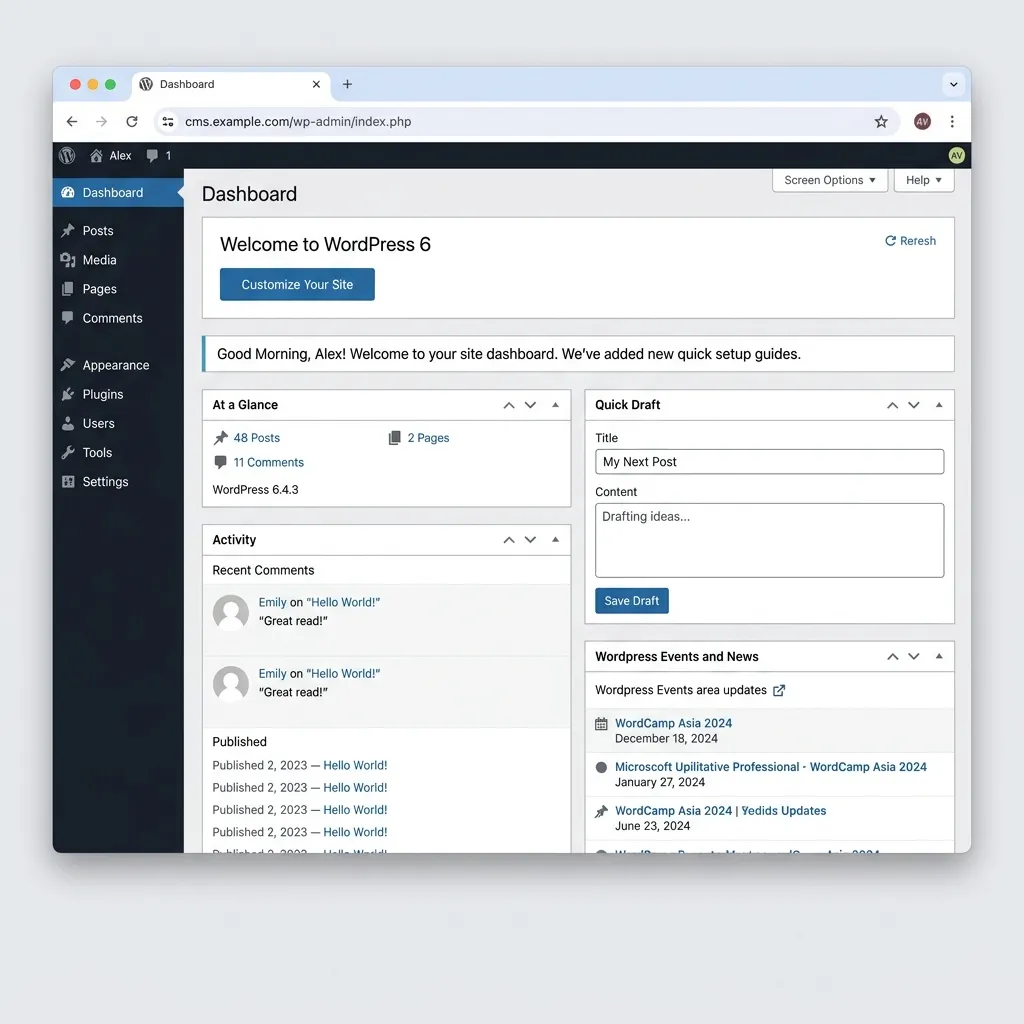
Same wp-admin →
A WordPress site administered from inside China runs the same wp-admin you already know, on infrastructure tuned for the local network.
What It Is For
Not the right answer for every project. For a specific set of use cases, still the best tool we have.
For brands selling in China outside Tmall or JD, WooCommerce is the closest thing the open web has to serious e-commerce. Add Alipay, WeChat Pay, and UnionPay and it covers most of what is needed.
Hundreds of pages, regular publishing, multiple authors. WordPress was built for this. Editors who already know it don’t need to learn anything new.
Chinese alongside English, French, German, or Japanese. WordPress with WPML or Polylang handles three or more languages cleanly, with separate sitemaps for Baidu and Google.
Marketing teams, content managers, regional offices update the site without a deployment pipeline. For independent China teams, that flexibility matters more than raw page speed.
Membership areas, conditional lead capture, gated content, sales enablement. The plugin ecosystem covers most of it out of the box.
Most sites we inherit are built in Elementor, Divi, or Gutenberg. All three work once the dependencies are cleaned up. Gutenberg is the lightest and easiest to keep fast on a Chinese server.
When It Isn’t the Right Call
We build both, so we can be honest about which fits. Astro is static-first, very fast on Chinese mobile networks, and the better answer for some projects.
Pick Astro
Pick WordPress
When in doubt, Strategy and Audit is where the conversation usually starts.
What Has to Change
A typical WordPress install fails in China out of the box. Here is what we change, grouped by where the work happens.
Google Fonts don’t load. We self-host, or swap in Chinese-compatible alternatives that ship Latin and CJK glyphs in one file.
Most ThemeForest themes call external CDNs, embed Google Maps, or load remote scripts that fail behind the Firewall. We audit, swap, and replace.
Each needs targeted cleanup. We strip Google Fonts loaders, replace external icon libraries with local ones, and disable anything that pings a blocked service.
YouTube becomes Youku or Bilibili. Vimeo becomes Tencent Video. Facebook pixels become WeChat or Weibo. Google Maps becomes Baidu Map or Amap.
WooCommerce alone won’t take a Chinese consumer’s money. We add Alipay, WeChat Pay, and UnionPay, and configure checkout the way Chinese users actually pay.
Yoast SEO needs Baidu sitemap support added. Google Analytics gets replaced with Baidu Tongji. reCAPTCHA needs a Chinese alternative. We keep a running list.
Mainland Chinese server, valid ICP filing on the domain. Aliyun, Tencent Cloud, or Huawei Cloud, depending on the project.
Core and plugins phone home to wordpress.org and frequently time out from inside China. We route updates through a proxy or schedule manual update windows.
Standard hardening: disable admin file editing, lock down xmlrpc, enforce 2FA, run a WAF on the Chinese cloud provider. Update discipline is stricter here.
CDN configured for mainland delivery. Caching layered. Database tuned for Chinese cloud servers. Target: under three seconds first meaningful paint on a mid-range Chinese phone.
Critical content lives in HTML. Baidu Webmaster Tools wired in. Site structured so Doubao, Kimi, DeepSeek and Wenxin can read and cite it.
Built on the Chinese stack
Mainland-licensed providers, real Chinese-network performance, and the consumer services your audience actually uses.
Hosting
Aliyun
阿里云
Hosting
Tencent Cloud
腾讯云
Hosting
Huawei Cloud
华为云
Search & SEO
Baidu
百度
Auth & messaging
微信
Payments
Alipay
支付宝
Elementor in China
An Elementor site that runs cleanly in Paris will almost certainly break or slow down when accessed from Shanghai. The builder is fine, the defaults are the problem.
Once tuned, Elementor is a strong fit for international brands whose China team needs to keep updating the site without a developer in the loop.
Elementor pulls Google Fonts by default, which don’t resolve in China. We self-host them or swap in Chinese-compatible alternatives.
Some widgets call blocked services (Google Maps, YouTube, Facebook, reCAPTCHA). We replace them with Chinese equivalents or custom ones.
External assets get rerouted to load locally from the Chinese server.
Most Elementor templates ship with assumptions that don’t hold in China. We audit and clean each one.
Plugin Migration
Most foreign WordPress sites arrive with 30 to 60 plugins; many break behind the Firewall. Each one lands in one of three buckets.
First choice
What we do most of the time. Google Analytics becomes Baidu Tongji. reCAPTCHA becomes a local captcha. Google Maps becomes Amap. Editors don’t notice.
When it fits
If the plugin doesn’t apply to a Chinese audience, we remove it. Fewer plugins, faster site, smaller attack surface.
Last resort
Critical plugin, no replacement: we modify the code. Reroute the API call through a proxy, or swap a hardcoded CDN URL. Only when the licence allows.
Every decision is documented. If you leave us, the next team picks up cleanly.
Timeline
ICP filing usually sits on the critical path. We start it on day one.
New site
Migration
ICP filing runs in parallel
Twenty business days minimum at the provincial level, sometimes longer. We start the filing on day one so it never blocks launch.
Frequently Asked
Get Started
Already on WordPress and it doesn’t work in China? We can usually fix it. Starting fresh and unsure whether WordPress or Astro fits? Strategy and Audit is where most engagements begin.