
A WordPress site is slow in China for four reasons, and they do not cost the same. A host that never answers can hold the whole page. The distance to your server adds most of a second to every request. The number of hosts you call multiplies that. Page weight comes last, and it is usually the first thing anyone touches.
Rank the four before you spend anything on any of them.
| Rank | Cause | What it costs | What fixes it |
|---|---|---|---|
| 1 | A host that never answers | The page, or whatever waits on it | Delete the call, or self-host the file |
| 2 | Distance to your origin | Most of a second on first byte | A mainland origin, or in-country delivery |
| 3 | The number of hosts you call | A lookup and a handshake each | Fewer origins, assets served from yours |
| 4 | The weight of what you ship | Time in proportion to bytes | Ordinary web performance work |
Most teams start at row four, because row four is what their tooling talks about. Rows one to three are where the seconds are.
The measured figures below come from an Alibaba Cloud region on 28 August 2026 and a Beijing consumer line on 30 August 2026. Each one carries where it was taken and when.
What slow means from Shanghai
The largest public test of foreign sites loading inside China was run by Chinafy, who sell a fix for the problem, so weigh it accordingly. The method is published, which is more than most of this category manages.
614 global websites across 11 verticals were tested with WebPageTest by Catchpoint from Beijing, Virginia and London, on Chrome over a cable connection. 66.4% of them failed to load successfully in Beijing, median visually complete time was 17.2 seconds, and of the tests run from Beijing, 44% timed out. Time to first byte from Beijing was 1.4 seconds, against 0.35 seconds from Virginia and 0.31 seconds from London. Source: Chinafy, State of Global Website Performance in China, April 2026. https://insights.chinafy.com/
Two thirds failing is the number everyone quotes. The one worth sitting with is 1.4 seconds, spent before your theme is parsed or a single image is requested.
The four causes of a slow WordPress site in China
One: a host that never answers
Binary, and the expensive one. A refused request fails fast. A silently dropped one sits there until the browser gives up, which can take a minute. The classic case in WordPress is jQuery loaded from Google Hosted Libraries, which thousands of commercial themes still do.
GreatFire’s most recent conclusive test of ajax.googleapis.com from mainland China failed, and the host is classified as blocked. Last tested 22 August 2026. Source: GreatFire. https://en.greatfire.org/https/ajax.googleapis.com
That would be survivable if the tag were lazy.
Scripts without async, defer or a module type “are fetched and executed immediately before the browser continues to parse the page”. Source: MDN Web Docs, the script element, last modified 9 May 2026. https://developer.mozilla.org/en-US/docs/Web/HTML/Reference/Elements/script
The page stops at the line where your theme asks Google for jQuery. Our guide to the plugins that break in China walks the rest of the host list.
Two: the distance to your origin
Your server is in Frankfurt. Every request from a visitor in Chengdu crosses the width of Eurasia twice before a byte comes back, then does it again for the next resource. That is the 1.4 seconds above. A mainland origin deletes the distance, and brings paperwork with it, which the last section covers.
Over a 90-day window, a mainland-hosted client site returned 99.98% uptime, with median response times of 48ms from Beijing, 36ms from Shanghai and 61ms from Guangzhou. Source: ChinaWebFoundry, published 29 August 2026. https://www.chinawebfoundry.com/website-in-china/
Those are our own figures. The carrier and the exact window are not published. A figure without its conditions deserves suspicion, including when we publish it.
Three: the number of hosts you call
Every separate host is its own tax, and not a small one once a round trip costs what it costs from China.
“Connecting is the time it takes for a TCP handshake to complete. Like DNS, the greater the number of server connections needed, the more time is spent creating server connections.” Source: MDN Web Docs, Understanding latency, last modified 25 February 2025. https://developer.mozilla.org/en-US/docs/Web/Performance/Guides/Understanding_latency
A WordPress install with a page builder, a form plugin, an analytics tag and a webfont reaches eight to twenty hosts before a visitor sees anything. One study instrumented real browsing from a Beijing home line, found 97 distinct third-party hosts, and had probed a cloud region inside China two days earlier. It probes five hosts directly. These three carry the argument, and the two vantage points disagree about two of them.
| Host | Alibaba Cloud (阿里云) cn-zhangjiakou, 28 Aug 2026 | Beijing China Mobile (中国移动) home line, 30 Aug 2026 |
|---|---|---|
| fonts.googleapis.com | Reachable. 72 of 72, 111ms median | Blocked. 0 of 54 |
| www.googletagmanager.com | Reachable. 72 of 72, 118ms median | Blocked. 0 of 112 |
| cdn.jsdelivr.net | Reachable. 72 of 72, 660ms median | Reachable. 36 of 36 |
The datacentre column was sampled every ten minutes for 12 hours on a 30-second timeout, 72 samples per host. The consumer column covers 88 websites and 264 page loads overnight. Source: 21YunBox, A Chinese Cloud Probe Is Not a Chinese Visitor: The Same Hosts, Opposite Answers, 2026. https://www.21cloudbox.com/a-day-of-third-party-requests-from-inside-china.html
Google Fonts answered every time from the datacentre and never once from the home line. Both results are real, and your visitors are on the second one. Self-host the font and that variable disappears. jsDelivr completes from both, which is why treating CDNs as one category gets this backwards.
Four: the weight of what you ship
Bytes cost time in proportion to bytes, and a Chinese mobile connection is a worse pipe than the one your designer tested on. The MDN page cited above puts it plainly: the greater the number and size of the requests, the greater the effect of high latency on the person waiting. So compress the images and cut the slider. That work pays, right up to the point where the page is sitting on a host that never answers.
A migration: 23.4 seconds to 1.2
One of our migrations moved a WordPress site off a European origin onto a mainland one and cleaned out its external calls on the way.
Median page load went from 23.4 seconds on a European origin to 1.2 seconds on a mainland origin, and roughly half of that improvement came from deleting external calls rather than from moving the server. Source: ChinaWebFoundry, published 29 August 2026. https://www.chinawebfoundry.com/resources/china-web-guide/is-wordpress-blocked-in-china/
Read the second clause twice. It decides your budget. Half the gain was free: deleting a Google Fonts call and self-hosting two woff2 files costs an afternoon. The other half needed the server to move, which needed an ICP filing (ICP备案) and a mainland entity behind it. The per-step breakdown belongs in a case study and is being written into one.
What a delivery layer fixes, and what it leaves
There is a real product category here and it works. Chinafy is the best-known vendor in it, and its published description is specific: a China-specific copy of your site, resources that fail swapped or stripped, the copy served over near-China content delivery networks, and geo-IP routing that sends only Chinese visitors to it.
“Dynamic requests (e.g. transactions) also return to your original site’s origin to ensure that real-time information is provided to visitors in China.” Source: Chinafy product documentation. The page carries no publication date, so this is the mechanism as read on 18 September 2026. https://www.chinafy.com/how-chinafy-works
Score it against the four rows. Row one is the product, so that goes outright. Row four is handled at the edge and most of row three with it, because the layer ends up serving those assets itself. Row two it only halves, since dynamic requests still cross the border.
Three and a half rows, with no ICP filing and no Chinese entity, because nothing sits on a mainland server. For a brochure site, a campaign microsite, or a team that needs Chinese visitors served next quarter instead of next year, that is the right purchase and we will say so.
What it leaves is the dynamic path. Checkout, login, search, a logged-in WooCommerce cart still travel to wherever your origin lives, carrying the first-byte cost with them.
What only a mainland origin fixes
Dynamic response time, and only by being in the country. There is a gate in front of that.
A domain pointed at a mainland-region server stays unreachable to visitors until its ICP filing (ICP备案) is approved. Visitors get a holding page, so no soft launch is possible. Source: Alibaba Cloud (阿里云) developer community, 20 March 2022, behaviour reconfirmed 18 September 2026. https://developer.aliyun.com/article/877910
Plan three to six weeks, assuming a mainland entity already exists. Our guide to WordPress hosting in China covers which domestic cloud to file with. The in-country CDN route hits the same gate, which catches out anyone assuming a CDN sidesteps the paperwork.
The Cloudflare China Network “is available as a separate subscription for customers on an Enterprise plan”, and “you must have a valid ICP (Internet Content Provider) filing or license for each apex domain you wish to onboard”. Source: Cloudflare developer documentation, last updated 30 April 2026. https://developers.cloudflare.com/china-network/
“JD Cloud, our partner, is required to review and vet the content of all domains on their network before China Network is enabled.” Source: Cloudflare developer documentation, last updated 17 April 2026. https://developers.cloudflare.com/china-network/get-started/
Cloudflare’s anycast routing can send visitors to a data centre farther away geographically. The visitor’s internet provider and its peering arrangements affect the path. Free or standard service does not include the separate China Network subscription.
Cloudflare says requests can reach a geographically more distant data centre because routing depends on the visitor’s internet provider and network conditions. Source: Cloudflare, Geographic traffic routing, 14 October 2026. https://developers.cloudflare.com/support/troubleshooting/general-troubleshooting/geographic-traffic-routing/
How to measure it honestly
Do not test through a VPN. A VPN measures your tunnel, and a tunnel is the one network condition none of your visitors have.
Name the vantage point every time, because a cloud region inside China and a home line in the same city return opposite answers about the same host, and only one of the two is your customer. Use each for what it is good for: the consumer line tells you whether something happens, the datacentre tells you how fast it could be. And date it. A result from March tells you about March.
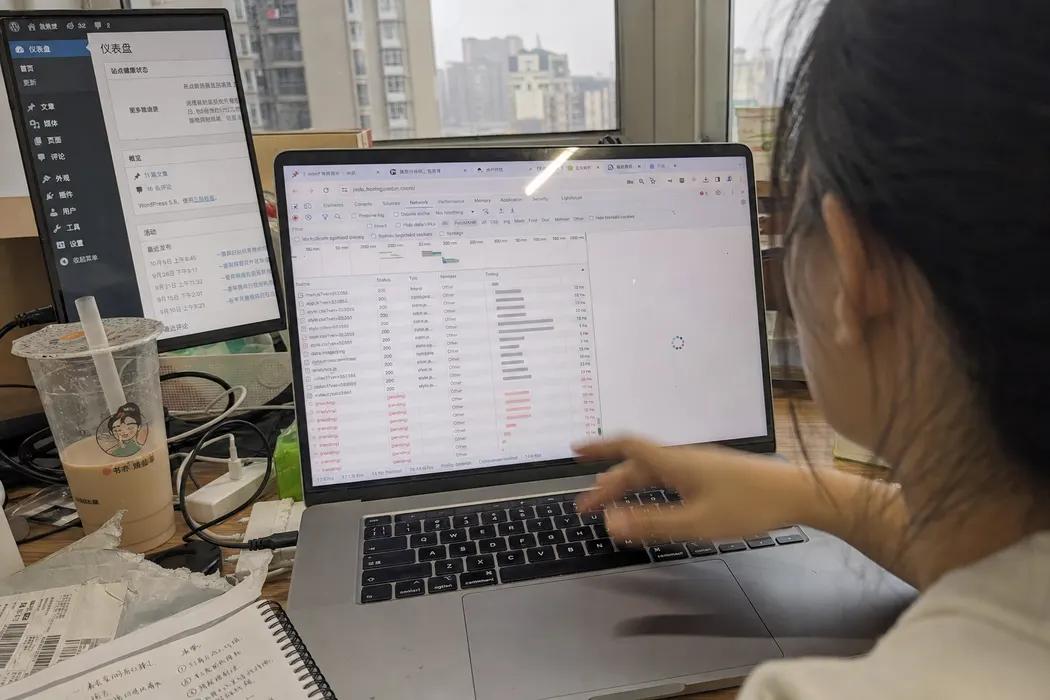
WebPageTest has a Beijing node. Chrome DevTools on a machine in China, sorted by domain, gives you the host list in about a minute. With nobody in the country, our free China Site Scanner checks a URL’s dependencies from where you are. Then hold the result against the four rows: seconds in row one mean an afternoon of work, seconds in row two mean a filing, and our WordPress in China page sets out which path suits which site.
Questions we get asked
Why is my WordPress site slow in China but fine everywhere else?
Because the parts that fail are parts nobody outside China ever requests. A blocked font host, an analytics tag that never answers, a script tag that stops the parser. From Europe they reply in milliseconds. From a Chinese home line they can hang until the browser gives up.
Will a caching plugin make my site faster in China?
It helps with row four and does nothing for rows one to three. Caching shortens the time your server spends building a page. It cannot shorten the distance to that server, or stop your theme calling a host that never answers.
Is a Hong Kong server good enough?
Better than Frankfurt, worse than Shanghai, and it needs no ICP filing (ICP备案), which is why people reach for it. Mainland traffic still crosses the border and still gets inspected, so the first-byte gain is real and partial. Treat it as a stepping stone.
What does fixing this actually involve?
Two different projects, and you should know which you are buying. Cleaning up external calls is developer work measured in days, and needs no permission from anyone. Moving the origin into the mainland needs a Chinese entity, an ICP filing (ICP备案) and weeks of waiting. Do them in that order.
How fast should a WordPress site load from mainland China?
Under two seconds is achievable on a mainland origin once the external calls are cleaned up. Two to five seconds usually means the origin is right and the dependencies are not. Above ten seconds, something is hanging rather than running slowly.
Need help with this?
ChinaWebFoundry handles WordPress projects in China end to end. If any of this feels like more than you want to tackle alone, get in touch.
Talk to Us