
The Challenge: Everyone Has Tried a Ladder, Everyone Has Watched One Die
Tennis ladders are an old idea. A standing ranking, you challenge someone above you, you win, you take their rung. Clubs have run them on spreadsheets for decades.
They die the same way every time. Someone gets challenged and never replies. Two players agree to play “soon” and then it’s August. The top four stop accepting matches because they have nothing to gain. The organiser chases people by WhatsApp until they stop caring too.
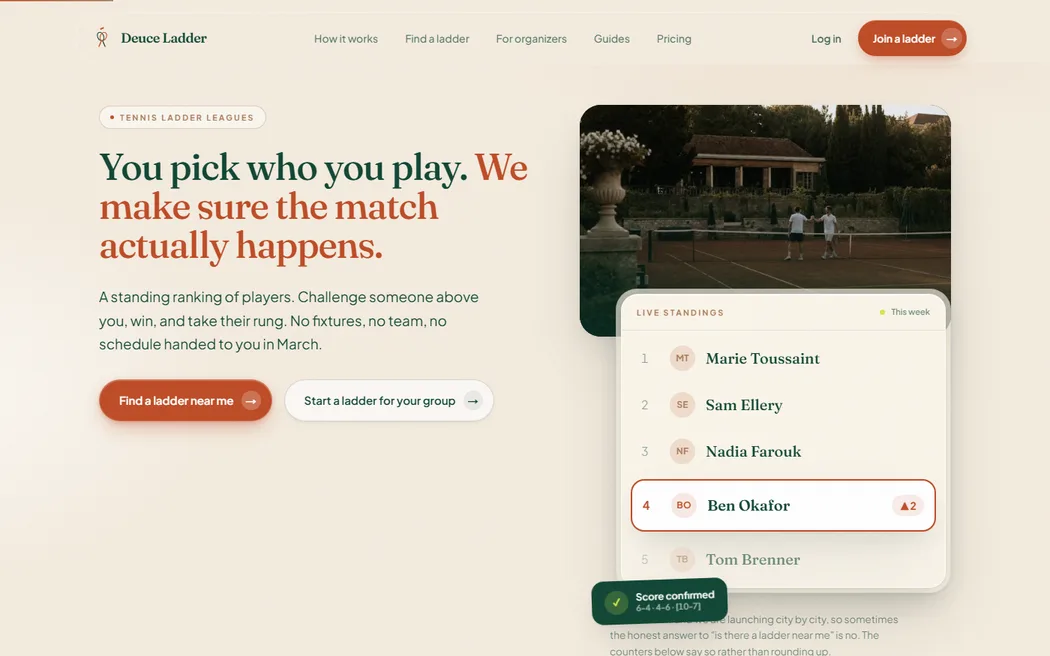
Deuce Ladder fixes that with rules and clocks. Challenge up to five rungs above you, 48 hours to respond, 10 days to play, walkover if you let the window pass, and your rung decays if you go quiet. Both players confirm the score, so nobody invents a result.
The problem for the website is that a rulebook is a hard sell. Two questions decide whether someone signs up, and neither is about features. Is there anyone near me on this thing, and will my opponent actually show up?
| Client | Deuce Ladder |
| Industry | Sports and recreation software |
| Audience | Club players and ladder organisers |
| Platform | Marketing site and product entry for a live league app |
| Key services | Audit, Design delivery, Integration, GEO |
The Build: Answer the Two Questions, Then Show the Clocks
The site answers the near-me question with live counters per city, and it shows a zero when the number is zero. Deuce launches city by city, so an honest empty state beats an inflated registration figure that gets found out on day one. A reader who sees no ladder nearby is offered the other route, start one for your group.
The show-up question gets answered with mechanics rather than reassurance. The format runs as five steps, join at a level, challenge up, two clocks start, play wherever you want, both players confirm. Each step names the deadline and what happens when it lapses. A separate section walks the first ten minutes after signing up, concretely, because that’s where most sports apps lose people.
Then a page that names the failure modes out loud, every way a ladder dies and the specific rule that handles it, laid out as pairs. Players who sit on a challenge, matches that keep sliding, the top of the table going quiet, seasons that never end. Fixed 6 to 12 week seasons and a rating that follows a player across ladders close the loop.
Two more pieces do the persuading. A ladder simulator, for organisers still running theirs in a spreadsheet, and a straight comparison against the biggest name in the category with the differences stated plainly rather than framed as a fight.
The whole site is written in question-and-answer shape, which is also what AI search wants. Twenty-five pages, each one holding a claim an assistant can quote, plus guides for organisers and a public changelog so the product looks maintained.
The Outcome: A Rulebook That Reads Like a Reason to Play
Deuce Ladder now has a site that sells the awkward part of the product. The deadlines, the walkovers, the decay, all the machinery that stops a league going silent, presented as the reason to join rather than the fine print.
Honest counters, named consequences and a public changelog do more for a young league platform than any promise about community, because a player deciding on a Tuesday night wants to know that the match will happen.
The website

Services used in this project
Want results like these?
Tell us about your project and we will map out what it takes to make your site work in China.
Talk to Us