
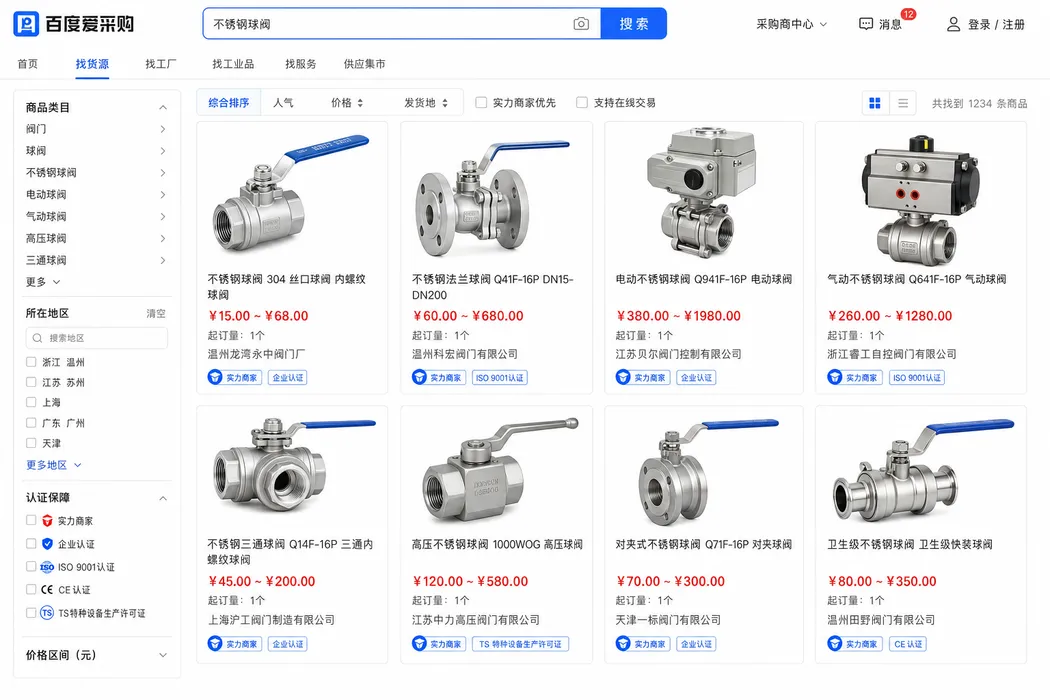
Baidu Aicaigou (百度爱采购, Bǎidù Àicǎigòu) is Baidu’s B2B vertical search product. Suppliers pay to be listed there, and those listings occupy top slots on Baidu results pages for queries carrying buying intent. In an industrial category, that describes a lot of the searches you would care about.
It is a paid channel. To the person searching, it does not look like one. That gap is where foreign marketing plans go wrong, and where having someone run your China marketing on the ground pays for itself.
The block above your ranking is not a ranking
When a procurement manager searches a product category, the supplier module comes first. The organic results come after it. Nothing on the page tells the searcher that the top block plays by different rules than the results underneath it.
So the misreading is predictable. A team pulls up its category keyword, sees a Chinese supplier nobody in the room has heard of sitting at the top, and decides the Chinese SEO program has failed. The SEO may be perfectly healthy. That position was never in the competition to begin with.
The numbers on Aicaigou come from a newspaper, not from Baidu
Baidu has never broken the product out on an earnings call, and there is no public dashboard to check. Almost everything in circulation traces back to one Chinese newspaper report from 2023.
Baidu Aicaigou matched more than 13 million business opportunities in a single year and accumulated over 200 million pieces of platform content.
Source: 南方都市报, June 14, 2023
The same report, not Baidu, described the trajectory.
Aicaigou’s user scale grew an average of 48% a year over three years.
Source: 南方都市报, June 14, 2023
Those figures are three years old. Baidu has not refreshed them and no independent audit exists, so use them for the one thing they establish: the platform is real and it transacts. They will not carry a forecast.
What makes any Baidu placement worth arguing about is the reach behind it.
Baidu held 46.65% of the search engine market in China across all platforms in September 2026, by Statcounter’s measure, and 60.15% on mobile. Source: Statcounter Global Stats, September 2026. https://gs.statcounter.com/search-engine-market-share/all/china and https://gs.statcounter.com/search-engine-market-share/mobile/china
Statcounter’s China panel bounces around, so hold the decimals loosely. The share is large enough either way to make the top of a Baidu results page expensive, which is why Baidu sells it instead of awarding it.
Membership is the floor, not the price
There is no published rate card. A Baidu marketing channel page has carried the annual figure since 2021, and Chinese service providers quote their own numbers around it. Read all of it as quotes rather than confirmed pricing.
Standard membership is quoted at RMB 6,980 a year. Service providers writing in 2026 put basic entry in a band of roughly RMB 6,000 to 8,000 a year, which tells you the figure has held its shape for five years and that resellers price around it rather than to it. Layered on top of membership is a cost per click, and that is the line item that breaks budgets. Membership buys the right to appear at all. Being seen inside the listing gets bought separately, click by click, against whoever else is paying for the same category.
There is no self-service door
None of that pricing matters until you can buy at all. Entry runs through an authorized service provider (服务商, fúwùshāng). Nobody opens an Aicaigou account with Baidu directly. You inherit a reseller, and their appetite for picking up the phone at five on a Friday is part of what you are buying.
The entry requirements service providers apply include a business license issued within six months. That lands on foreign companies the way every other Baidu commercial product does. It assumes a mainland entity. Without one you are operating through somebody else’s license, and the account then belongs to whoever signed for it. Settle that before onboarding rather than after.
The same layer is why quoted pricing wanders. Treat the figures above as a reference point. Nobody is bound by them.
Your product page and the marketplace are chasing the same query
Set the paperwork aside and look at the arithmetic. Pick one commercial term in your category. You can go after it on your own site with a Chinese product page and the specification sheet behind it. You can also appear against it as an Aicaigou listing. Same search, two routes in, and one of them starts above the other.
Most marketing plans file this under organic versus paid, which misses what is happening. One slot can be rented this month. The other might be earned over a year of Chinese content work, and it sits lower on the page when it arrives.
So the first move is not a content brief. Search the ten or twenty terms that matter on Baidu from a mainland connection and record what sits at the top of each page. Split the list in two: terms where an Aicaigou module owns the top, and terms where organic results still start high. The second group is where owned content earns its money. The first is a pricing conversation. We run that check before writing anything, and it reorders the plan often enough to be worth the afternoon.
Renting visibility against building it
An Aicaigou listing is a tenancy. Baidu sets the layout and the price. Baidu also decides which competitors stand beside you on the screen, and there is no version of the product where you get to be the only supplier shown. Stop paying and the visibility ends that week. You do not keep the audience either. Someone who found you inside the marketplace was a marketplace user who happened to land on your row.
A ranking on your own site behaves differently. It is slower to get and harder to justify to a finance director who wants leads this month. It also survives a budget freeze, which the listing does not. The visitor lands on a page where you control the technical detail and the next step, with no competitor beside you.
Which one fits depends mostly on what you sell. Aicaigou suits companies that need pipeline inside the quarter, already hold a mainland entity, and sell something comparable enough that appearing in a supplier list costs them nothing. Commodity industrial goods do fine there. It works less well when the specification does the persuading, or when a row of domestic manufacturers turns your product into a price line.
Running both is defensible, and not only as a hedge. The paid channel shows which terms actually produce inquiries while your own pages are still waiting to be indexed, months before Baidu’s reporting would tell you anything. Point the owned content at what it finds.
Aicaigou packaging and pricing move through resellers, so confirm current terms with a service provider before you budget anything.
Need help with this?
ChinaWebFoundry handles WordPress projects in China end to end. If any of this feels like more than you want to tackle alone, get in touch.
Talk to Us