
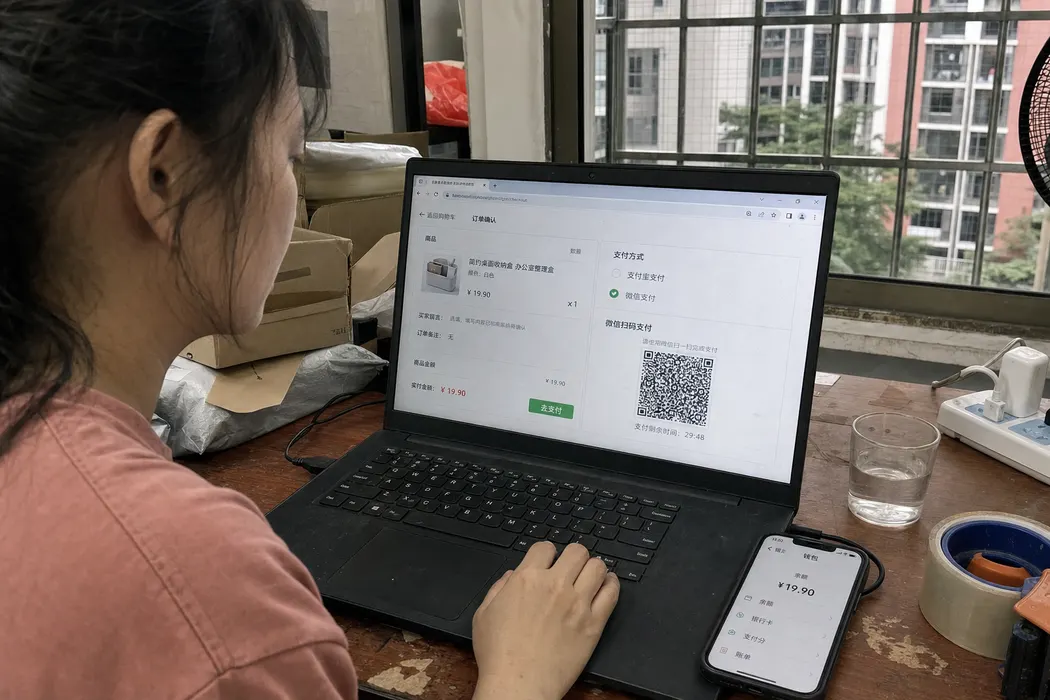
To accept payments on a China website, start with the company that will receive the money. An overseas business may qualify to take Alipay (支付宝) or WeChat Pay (微信支付) through its existing provider. A mainland entity needs a provider that accepts that entity and its sales model. UnionPay (银联) is another route to assess with an acquiring bank, which handles payment acceptance for the merchant, or a payment provider.
| Your situation | Route to investigate | Approval to establish first |
|---|---|---|
| Overseas company, existing Stripe account | Supported wallet methods on that account | Account country, business category and wallet eligibility |
| Mainland company, domestic online sales | Domestic payment provider or acquiring bank | Merchant onboarding and the specific online payment product |
| Overseas company, no suitable provider | Cross-border provider that accepts your entity | Country, goods, buyer market and settlement account |
| Shopify store | Providers available for the store and business | Platform support for the approved payment method |
Write down where the seller is registered and where the buyers live. Record the server location separately. A developer can then assess the checkout against the merchant account the business can actually open.
Provider documentation checked on 25 October 2026. Account approval remains specific to the applicant and the product being sold.
Using Stripe to accept payments on a China website
Stripe’s supported merchant-country list includes Hong Kong and excludes mainland China. An international business already using Stripe should then check its wallet eligibility. Stripe publishes support for Alipay (支付宝) and WeChat Pay (微信支付) for businesses in specified countries, including the UK, France and the US.
Stripe lists Hong Kong among supported merchant locations; mainland China is absent. Its wallet documentation lists eligible overseas businesses that can accept payments from Chinese consumers. Source: Stripe, Global availability and wallet documentation, checked 25 October 2026. https://stripe.com/global https://docs.stripe.com/payments/alipay https://docs.stripe.com/payments/wechat-pay
Ask which legal entity owns your account and which entity appears on the customer’s order. If your mainland subsidiary sells the goods, avoid building its checkout around the parent company’s account without the provider’s written acceptance of that arrangement.
Keep the network question separate. Our evidence register has no dated
third-party test for js.stripe.com, so its mainland reachability is
untested. Merchant eligibility documentation establishes who can apply;
it supplies no measured checkout success rate.
Settlement is the later transfer of the payment proceeds under the merchant agreement. Establish who holds the contract. Record the account that will receive the proceeds.
Alipay, WeChat Pay and UnionPay have different products
For Alipay (支付宝), confirm the provider’s supported merchant locations and sales categories before requesting credentials. An overseas business can investigate a cross-border provider; the application must cover the actual products and destination market. Ask whether the contract supports your website’s payment flow and the currency you want to receive.
WeChat Pay (微信支付) needs the same account check, plus attention to the browser. A customer opening a page inside WeChat has a different payment journey from someone using a desktop browser. If you intend to offer a desktop QR scan or phone-to-app hand-off, confirm that flow with the provider. A direct JSAPI integration uses WeChat’s browser payment API. WeChat Pay’s documentation requires permission for that product and details of the official account to be bound to it.
WeChat Pay’s JSAPI application guide distinguishes an existing merchant adding product permission from a new merchant applying during onboarding. Source: WeChat Pay (微信支付), updated 27 June 2025. https://pay.wechatpay.cn/doc/v3/merchant/4012791854
For UnionPay (银联), ask an acquiring bank or payment provider specifically about online acceptance. Establish which cards and buyer locations it supports. A shop’s physical terminal agreement is insufficient evidence that the same merchant has an approved website integration.
UnionPay International’s developer-platform announcement describes online payment APIs and acquiring services within its cross-border programme. Source: UnionPay International, 3 January 2019. https://www.unionpayintl.com/en/mediaCenter/newsCenter/companyNews/4835.shtml
That announcement establishes the route’s existence. For a new application, get the current eligibility and integration terms from the provider.
Prepare the merchant application before the checkout
Send the provider a short description of the sale and the parties involved. For goods, add the dispatch location. State where funds should arrive, then include the website URL and product category. Request the document list for that arrangement; requirements vary by merchant country.
Antom’s onboarding guide, for example, asks for registration information and varies its ownership and representative modules by region. It places payment-method activation after merchant-account review and activation.
Submitting the documents leaves the application subject to that review.
Antom documents business registration, region-specific company and ownership information, account review and subsequent payment activation. Source: Antom, Merchant onboarding, 22 April 2026. https://iopenhome.alipay.com/docs/ac/merchant_service/merchant_onboard
Prepare the documents in the legal name used by the account holder. Ask who must approve changes if the selling entity or bank account changes after launch. Give the finance team access to this discussion; they will have to match the eventual payouts to orders.
Start with the currency shown on the product page. Check whether the charge uses that currency, then ask what reaches the bank. Finance should be able to trace any conversion and explain a difference between the order total and the deposit without asking a developer to reconstruct it from server logs (request a sample settlement report during onboarding).
Keep that report with the integration records.
| Confirm with the provider | Why the answer affects the build |
|---|---|
| Approved entity and business category | Determines which merchant credentials belong in production |
| Wallet or card product enabled | Determines which payment button and API the site can use |
| Desktop, mobile browser and in-app support | Determines redirects, QR display and return handling |
| Currency charged to the buyer and currency paid to the merchant | Determines what customers see and what finance reconciles |
| Refund process and notifications | Determines order states and customer-service actions |
| Settlement reports and account access | Determines who can trace missing or delayed funds |
Website filing is a separate workstream. Alibaba Cloud (阿里云) requires an ICP filing (ICP备案) for mainland-hosted sites under its filing guidance. The hosting account and filing entity need checking before a mainland deployment. Payment-provider approval does not complete that process.
Alibaba Cloud’s filing overview requires filing for websites hosted in mainland China and distinguishes overseas or Hong Kong hosting. Source: Alibaba Cloud (阿里云), 26 August 2026. https://help.aliyun.com/zh/icp-filing/basic-icp-service/user-guide/icp-filing-application-overview
Our guide to ICP filing for foreign companies covers that decision. Have the site’s actual business activity assessed before treating any commercial licence as required merely because a checkout exists.
WooCommerce has wallet plugins; check the account behind them
WooCommerce’s Stripe extension documents Alipay (支付宝) and WeChat Pay (微信支付). Its settings let merchants enable supported additional payment methods. A method can stay hidden when the currency or customer location doesn’t meet its requirements. Stripe may also need to approve it.
WooCommerce lists Alipay and WeChat Pay among the Stripe extension’s supported additional payment methods and documents eligibility checks. Source: WooCommerce, Additional payment methods, updated 6 May 2026, checked 25 October 2026. https://woocommerce.com/document/stripe/setup-and-configuration/additional-payment-methods/
For an eligible overseas seller, this is a concrete integration to review before commissioning custom payment code. Check the extension’s current support for your checkout, including any subscription or booking flow.
A mainland merchant can instead ask its approved provider about a maintained WooCommerce connector. If the provider groups several payment methods behind one integration, establish which company signs the merchant agreement and which one handles settlement. Find out who will fix a payment failure after a WooCommerce update.
Keep the production account under the merchant’s control. The implementation team needs access to connect and support it; record who can revoke that access at handover.
Give the developer acceptance cases covering a cancelled payment, a delayed notification and a repeated notification. Include a refund. The order system must handle a buyer who pays successfully and then closes the tab before returning to the shop. Release the order against verified provider confirmation, with the amount and order reference matched.
Assign someone to monitor the provider’s server notifications and match each transaction to the store’s order identifier. A repeated success message must not release the same order twice. A refund request needs a visible pending state until the provider confirms its result; customer support needs to find that state without editing the database. For subscriptions, obtain explicit confirmation of recurring-payment support on the chosen account and connector before promising renewals.
Our WooCommerce store guide for China covers the surrounding address and delivery work. Keep payment-account ownership in the same implementation record as the store settings.
Shopify limits the provider choices at checkout
Establish the platform route before commissioning a connector.
For a Shopify store, start in Settings > Payments and confirm which providers are available for the business location. Ask the chosen provider to confirm support for the specific wallet and checkout flow. A provider’s general API documentation alone cannot establish Shopify support.
Shopify’s China-specific requirements describe invitation-only early access for mainland entities selling cross-border, with a verified WorldFirst account. They explicitly exclude domestic sales to customers in mainland China. This distinction matters when the project is a Chinese store selling to Chinese customers.
Shopify Payments in China is invitation-only early access for eligible mainland businesses selling cross-border. Domestic sales to mainland customers are excluded; a verified WorldFirst account is required. Source: Shopify, Requirements for using Shopify Payments in China, checked 25 October 2026. https://help.shopify.com/en/manual/payments/shopify-payments/supported-countries/china/requirements
Shopify’s general China setup page still describes third-party providers as required for mainland merchants. Confirm the route actually available to your account before setting the launch date. Include any platform transaction charge alongside the provider’s fees when comparing offers.
Shopify’s general China setup guide documents third-party providers and additional platform transaction fees. Source: Shopify, Setting up payments for merchants in China, checked 25 October 2026. https://help.shopify.com/en/manual/intro-to-shopify/initial-setup/sell-in-china/set_up_payments
Choose the selling entity with finance and operations
An overseas seller collecting from Chinese buyers and a mainland subsidiary collecting domestic sales have different application records. Decide which business will fulfil orders and handle returns before choosing the payment account. Finance and operations should approve the sales model and retain the provider’s dated acceptance of it.
Keep the goods’ import route in the operations plan too. Approval to collect a cross-border payment does not establish how the shipment clears customs. Have the fulfilment team confirm that process separately for the goods being sold.
Compare conversion and refund costs alongside the transaction fee. Settlement conditions, including any reserve, affect when the money becomes available. Get the terms in writing, with sample reports showing how an order becomes a bank deposit. Don’t assume a direct connection will cost less at your volume.
For the wider launch, our website-in-China planning guide connects these choices to hosting and content. Record provider approval, the enabled products and the owner of the reconciliation process in the handover.
Frequently asked
Can an overseas company accept Alipay without a mainland entity?
Yes, eligible overseas businesses can apply through providers that support that arrangement. Stripe’s Alipay documentation lists supported merchant countries. The business category and account still need approval. Confirm the actual selling entity, the goods or services and the buyer market with the provider before building the checkout.
Do I need a separate plugin for WeChat Pay?
That depends on the provider and platform. WooCommerce’s Stripe extension lists WeChat Pay among its supported methods for eligible accounts. A direct merchant integration or another provider may use a different connector. Confirm support for the browser journey you intend to offer, especially payments opened inside WeChat itself.
Does a payment button prove the checkout is ready?
It proves only that the button is visible. Check authorisation and match the order to the provider’s transaction record. Confirm refunds and payout reconciliation before launch. Give buyers a way to recover a pending order without paying again while the first result is unresolved. Keep an order reference available to support, and record these acceptance checks for each supported journey.
Need help with this?
ChinaWebFoundry handles WordPress projects in China end to end. If any of this feels like more than you want to tackle alone, get in touch.
Talk to Us