
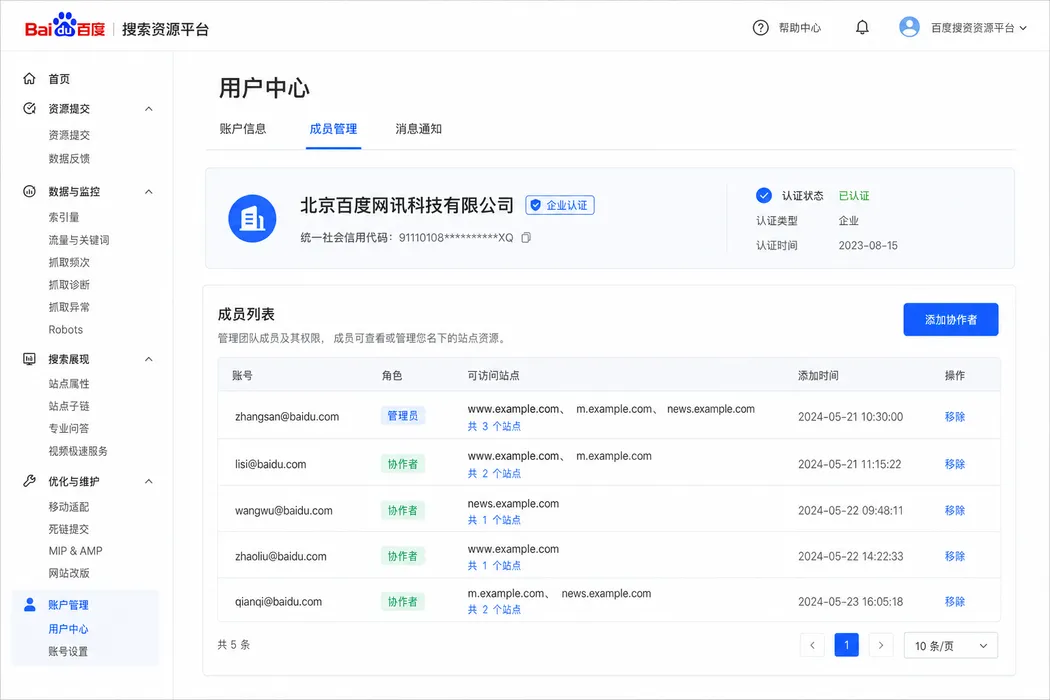
The Baidu account gets filed as an operational detail. It lives in a password manager, or it does not, and nobody raises it until a contract ends or a marketing manager quits. Then it stops being technical. The identity on that account is the closest thing Baidu keeps to a title deed for your China search presence, so check whose name it carries before an agency on the ground sets one up on your behalf.
Baidu held 46.65% of the search engine market in China across all platforms in September 2026, by Statcounter’s measure, and 60.15% on mobile. Source: Statcounter Global Stats, September 2026. https://gs.statcounter.com/search-engine-market-share/all/china and https://gs.statcounter.com/search-engine-market-share/mobile/china
Close to half of China’s searches, and six in ten on a phone, go through one company. This is not an IT housekeeping item.
Real-name verification is the ownership record
To do anything inside the Baidu Search Resource Platform (百度搜索资源平台, Bǎidù Sōusuǒ Zīyuán Píngtái) you need an account that has passed real-name verification (实名认证, shímíng rènzhèng). That ties the account to a legal identity, usually a mainland ID card or a company’s unified social credit code (统一社会信用代码, tǒngyī shèhuì xìnyòng dàimǎ). An ordinary foreign passport is not on the accepted list.
Baidu is unusually blunt about what that binding does.
实名认证直接影响账号和资源的归属
Real-name verification directly determines ownership of the account and its resources.
Source: Baidu, account management documentation
So Baidu account ownership does not follow the invoice. The verified identity owns the sites registered under it, along with the submission history and every index and keyword report those sites produced. Your team’s login, if you have one, is a permission somebody else granted and can take back.
The autumn that raised the stakes
For years an unverified account was an annoyance. You lost a few features and nobody escalated it.
September 2023 ended that. Baidu published two notices eighteen days apart. The first cleared out verification relationships held by accounts that had never completed real-name verification, along with sites it classed as risky or low quality. The second recalled submission quotas from the same population: sitemap submission shut off, API push allowances cut. The effects were widely reported as landing by that November.
That made the identity behind the account an operating dependency, not just a legal footnote. And look at what the first notice did: Baidu removed verification relationships. The ownership record is not permanent even for the party holding it, and nobody gets an email.
Two things to check this week: whether the account shows a completed real-name record, and whether sitemap submission is open to you. If that tool is missing, the account either never passed verification or had its quota recalled.
Baidu tells companies not to use an employee’s identity
The warning sits in Baidu’s own account guidance, and companies skim it because it reads like boilerplate. An employee-registered account behaves exactly as designed. The company has no claim on it, because the company is not the verified identity.
Picture the office manager who set the account up in 2021, because hers was the only phone in the building that could take the SMS code. She works for a competitor now. Her ID is still the ownership record for your China search property, and if she stops answering email there is no offboarding checklist and no support ticket that gets you out of it.
There is no transfer button
Baidu documents no ownership transfer flow. You cannot reassign a verified site from one account to another, and nothing here works like the transfer code a domain registrar hands you on request. What the platform gives you instead is a screen for adding people to a site, sitting next to a real-name record that decides who owns it. Only one of those two things was designed to move.
What recovery really looks like
The reassuring part first. You do not lose the domain.
Baidu verifies a site by testing whether you can change what the server delivers. It gives you an HTML file for the document root, or a meta tag for the homepage head. Control of that file or that tag is control of the domain, as far as the platform is concerned. A new account under your own entity can verify the same domain from scratch, any time you can edit the site.
What you lose is continuity. Index volume history, keyword reports, the submission record: none of it follows you across. On a site with three years behind it, that hurts, and it hurts at the moment you are already unhappy with somebody.
One sequencing trap catches people. Re-verification depends on server access, so if the provider holding the account also holds the hosting or the DNS, your recovery path runs straight back through them. Untangle that early rather than during a dispute. Move the DNS into your own registrar account first, if nothing else.
The arrangement that works: one owner, several collaborators
Baidu built for shared teams and almost nobody uses it. Under user center (用户中心, yònghù zhōngxīn), then site management (站点管理, zhàndiǎn guǎnlǐ), the owner of a verified site adds other Baidu accounts and assigns each a role: owner, administrator or normal user.
The commercial question is which role your company holds. Owner is the one tied to real-name verification, so that is where the client entity belongs. The other two are permissions handed down from it. A well-run engagement asks for an administrator seat and leaves the owner alone.
The detail that makes this workable is that sub-users do not need their own real-name verification. Your agency’s Baidu specialist and your marketing lead in Singapore each hold a personal login at the level you set, and neither needs a mainland ID card. So there is no remaining excuse for a shared password. If credentials are circulating by email on your project, the platform is not the reason.
The questions to ask before you sign
None of this is an argument against working with an agency. Registering under an agency license is legitimate, and for a company with no Chinese entity it is often the only route open. It is standard practice here, and we do it ourselves in those cases. The damage comes from leaving the exit undefined.
Four things belong in the contract rather than an email thread: the legal identity the account is verified against, whether your staff hold named collaborator seats and at what role, what happens to the account on the last day of the engagement, and whether the provider will cooperate with a re-verification under your entity. That last one is the mechanism you would actually use.
Where a client has a Chinese entity, we register the site under the client’s own license and take an administrator seat. The account belongs to the company that owns the website. We keep working access for as long as the client wants us to have it, and handing that back takes five minutes.
Baidu changes platform policy without notice, so confirm current account rules before relying on any of this contractually.
Need help with this?
ChinaWebFoundry handles WordPress projects in China end to end. If any of this feels like more than you want to tackle alone, get in touch.
Talk to Us